Hero Image

Capabilities

Four Classes. Published Evidence.

Four Classes. Published Evidence.

↳

The peptide classes Amidera builds, and the peer-reviewed results behind them.

What We Make

Amidera builds four classes of complex peptide. Each one is difficult for conventional synthesis, and each is where high-shear chemistry earns its place. The results below are drawn from peer-reviewed work.

The Classes

Four classes, one platform.

Four classes, one platform.

These are the architectures conventional synthesis struggles with: cyclic, glycosylated, phosphorylated and long modified sequences. Where we have published results, they are shown. Where the evidence is still building, we say so rather than fill the gap.

Cyclic peptides

Glycopeptides

Phosphopeptides

Long modified sequences

white truck on a road

The classes

[01]

Cyclic peptides

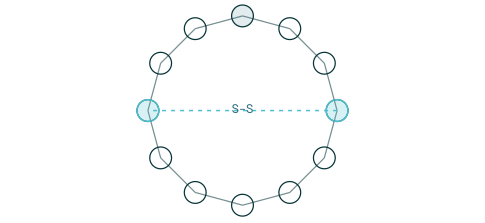
Head-to-tail and disulfide-bridged architectures. Somatostatin-14, a disulfide-bridged 14-mer, has been synthesised and benchmarked directly against microwave SPPS. Broader validation of cyclic capability is ongoing.

Service Image

[01]

Cyclic peptides

Head-to-tail and disulfide-bridged architectures. Somatostatin-14, a disulfide-bridged 14-mer, has been synthesised and benchmarked directly against microwave SPPS. Broader validation of cyclic capability is ongoing.

Service Image

[01]

Cyclic peptides

Head-to-tail and disulfide-bridged architectures. Somatostatin-14, a disulfide-bridged 14-mer, has been synthesised and benchmarked directly against microwave SPPS. Broader validation of cyclic capability is ongoing.

Service Image

[02]

Glycopeptides

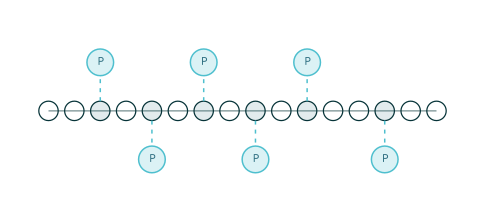
Multiple glycosylation sites completed in a single run. Published work covers up to three N-glycosylation sites on a 19-residue sequence at over 45% crude purity, three O-glycosylation sites reaching 80% on 1.2 equivalents of building block, and heterogeneous multi-glycosylated peptides above 60%.

Service Image

[02]

Glycopeptides

Multiple glycosylation sites completed in a single run. Published work covers up to three N-glycosylation sites on a 19-residue sequence at over 45% crude purity, three O-glycosylation sites reaching 80% on 1.2 equivalents of building block, and heterogeneous multi-glycosylated peptides above 60%.

Service Image

[02]

Glycopeptides

Multiple glycosylation sites completed in a single run. Published work covers up to three N-glycosylation sites on a 19-residue sequence at over 45% crude purity, three O-glycosylation sites reaching 80% on 1.2 equivalents of building block, and heterogeneous multi-glycosylated peptides above 60%.

Service Image

[03]

Phosphopeptides

Densely phosphorylated sequences with minimal to no chain damage. Published work demonstrates feasibility at up to six phosphorylation sites, and a triple-phosphorylated, fluorescently labelled peptide of up to 23 residues.

Service Image

[03]

Phosphopeptides

Densely phosphorylated sequences with minimal to no chain damage. Published work demonstrates feasibility at up to six phosphorylation sites, and a triple-phosphorylated, fluorescently labelled peptide of up to 23 residues.

Service Image

[03]

Phosphopeptides

Densely phosphorylated sequences with minimal to no chain damage. Published work demonstrates feasibility at up to six phosphorylation sites, and a triple-phosphorylated, fluorescently labelled peptide of up to 23 residues.

Service Image

[04]

Long modified sequences

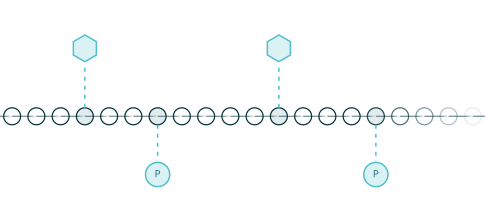
Where conventional synthesis breaks down. A 29-residue glycopeptide has been synthesised in full at 20 mL scale and reproduced across triplicate runs. Published evidence at greater length and complexity is still building.

Service Image

[04]

Long modified sequences

Where conventional synthesis breaks down. A 29-residue glycopeptide has been synthesised in full at 20 mL scale and reproduced across triplicate runs. Published evidence at greater length and complexity is still building.

Service Image

[04]

Long modified sequences

Where conventional synthesis breaks down. A 29-residue glycopeptide has been synthesised in full at 20 mL scale and reproduced across triplicate runs. Published evidence at greater length and complexity is still building.

Service Image

Why It Matters

The platform changes what complex peptides cost to make. Faster cycles, less expensive material, and access to the hardest sequences.

The platform changes what complex peptides cost to make. Faster cycles, less expensive material, and access to the hardest sequences.

The platform changes what complex peptides cost to make. Faster cycles, less expensive material, and access to the hardest sequences.

Rapid assembly

Couplings in 10 to 30 seconds. Faster synthesis cycles, and more runs from every reactor.

Material efficiency

As little as 2.0 equivalents of amino acid. Less spent on the costliest inputs in the process.

Complex PTM synthesis

Multiple glycosylation and phosphorylation sites in a single run, where conventional synthesis is slowest.

On-resin chemistry

Deacetylation on the resin in 15 minutes. Fewer steps after cleavage, and less handling.

The Benchmark

Measured against the best conventional method.

Somatostatin-14, a 14-residue disulfide-bridged peptide, synthesised on both platforms and compared directly. Faster couplings, less than half the amino acid, and higher crude purity.

[Microwave SPPS]

[Microwave SPPS]

120 sec coupling. 5.0 eq amino acid. 43% crude purity.

[Amidera HSPS]

[Amidera HSPS]

30 sec coupling. 2.0 eq amino acid. 64% crude purity.

Let's Get to Work

Better Peptide Economics Today. New Peptide Possibilities Tomorrow.

Better Peptide Economics Today. New Peptide Possibilities Tomorrow.